Ownership and Maintenance
What a Porsche Pre-Purchase Inspection Should Check
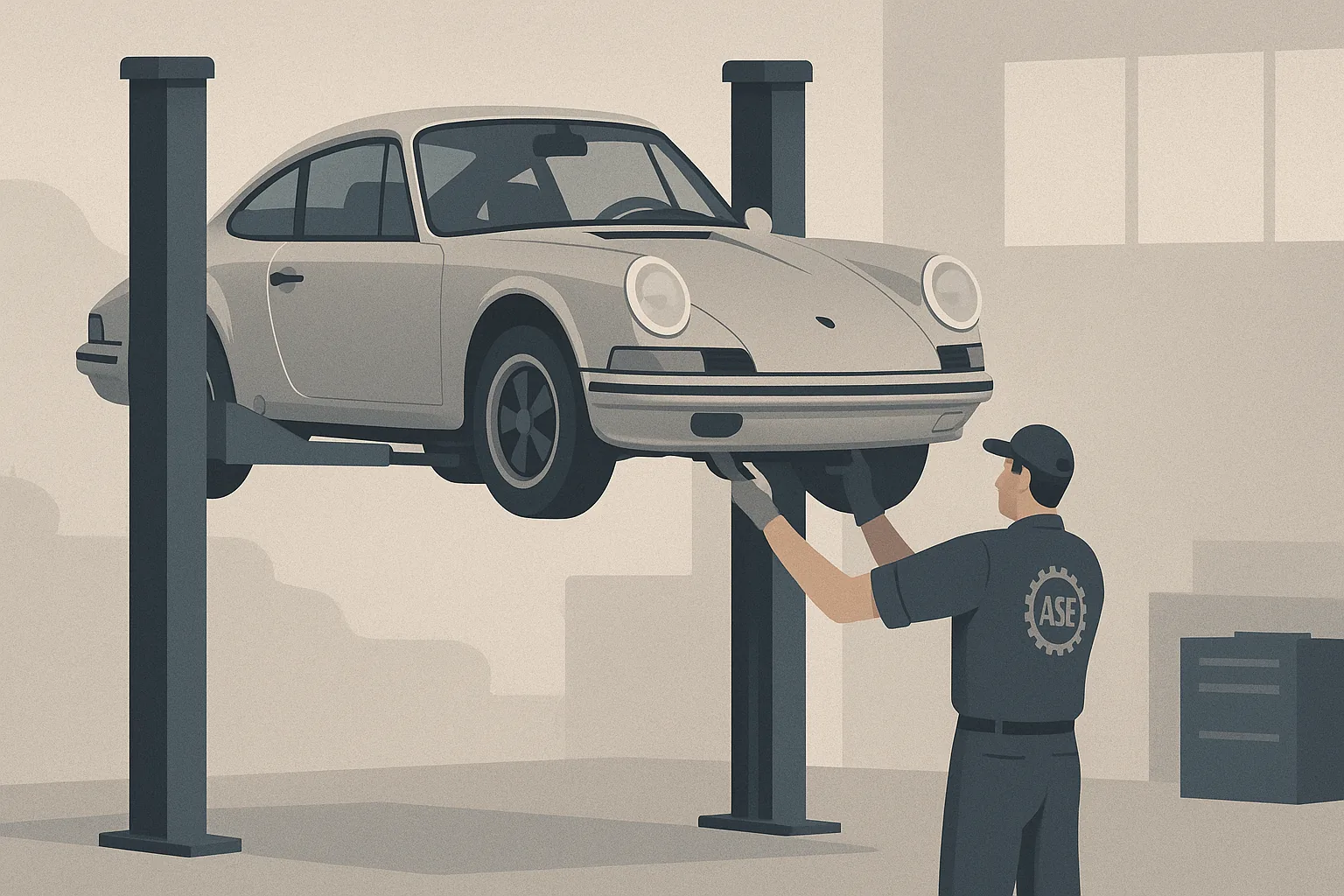
A Porsche pre-purchase inspection should check the things that are expensive on that specific generation, not just the tires and brakes. I'm Shawn Baker, founder and ASE Certified Master Technician at Luxury Motors of South Bay in Hermosa Beach, and our pre-purchase inspection service puts every car on the lift and on a dealer-level scan tool before you commit.
A 2002 911 and a 2022 911 share a name and very little else under the skin. The right checks follow the engine, the transmission, and the electronics of the generation you're looking at. Here's how that breaks down.
What should every Porsche pre-purchase inspection check?
Every Porsche inspection should start with a full scan of every control module, then a hands-on look at the engine, cooling system, drivetrain, suspension, brakes, and body. Our inspection process covers those same eight areas on every car. Use this as your baseline, then add the generation-specific items below.
The baseline looks like this:
- Stored and pending fault codes across every module, plus signs codes were cleared recently
- Oil leaks at the usual gasket and seal points, and evidence of oil consumption
- Coolant pipes, hoses, water pump, and radiators
- Transmission behavior and whether a PDK or Tiptronic has been serviced on time
- Control arms, bushings, shocks, and any air suspension
- Pad and rotor condition, and whether the tires match each other
- Panel gaps, paint, and underbody signs of previous repair
- Service records checked against what the car actually shows
Records matter more on a Porsche than on most cars. A thick folder only helps if the work in it matches what we see on the lift.
Why does the model generation change the inspection?
Porsche changed engines, transmissions, and electronics mid-generation, so the same nameplate can hide very different hardware. Porsche's own history of the 997 notes that 213,004 cars were built between 2004 and 2012, and that the 2008 update revamped the engine range with direct fuel injection. Confirm the exact model year and build before the inspection so the right checks get done.
That's why we ask for the year and model when you book. It tells us which engine and transmission to expect, and which known issues apply.
What matters most on a 996 or 986 Boxster?
On the 996 911 and the 986 Boxster, the engine is the priority. These M96 engines carry the intermediate shaft bearing concern, along with bore scoring, rear main seal leaks, and air-oil separator failures. Our page on common Porsche problems covers each one in more detail.
An inspection on these cars should look for oil leaks around the rear of the engine, oil consumption, cold-start noises, and the cooling system. It should also check the paperwork for any intermediate shaft bearing work, since some owners have already addressed it. No inspection can see inside a running engine, so the goal is to read every outside sign that is available.
What changes between an early and late 997?
The big dividing line is the 2008 update. Porsche introduced its PDK dual-clutch transmission on the 997 that year, according to Porsche's own story on the 997, alongside the new direct-injection engines. Check which side of that line the car falls on, because the inspection priorities shift.
On an earlier 997, the checks look closer to the 996, with attention to bore scoring signs, the air-oil separator, and rear coolant pipe connections. On a later car, PDK service history and shift quality move up the list, along with the usual leaks and cooling checks.
What should you check on a 991 or 992 911 and the 718?
On the newer cars, electronics and maintenance compliance carry more weight than the old engine concerns. A full module scan matters here, because software faults and battery drain issues show up in stored codes before they show up on the dash. Ask for the service history before the inspection so we can compare it against the schedule.
PDK service intervals, tire wear patterns that hint at alignment or suspension issues, and brake condition all get a close look. Any car that has been modified gets extra attention to wiring and anything that has clearly been apart before.
What about a Cayenne or Macan?
Porsche SUVs are heavier and more complex, so the inspection leans toward cooling, suspension, and drivetrain. Plastic coolant pipe failures are a known pattern on older Cayennes, and the Macan has its own coolant tank and pipe issues. Look at air suspension, brakes, and transmission service history with the same care as the engine.
These are also family vehicles that rack up short trips and stop-and-go miles. That kind of use wears brakes, suspension bushings, and batteries faster than the odometer suggests.
What do you get from an inspection at our shop?
You get photos of what we found and a plain-language explanation, sorted into urgent, normal wear for the mileage, and items to plan for later. We work for you, not the seller, and we don't sell cars. Take the findings into your negotiation or use them to walk away.
If you want the bigger picture on how inspections work for any make, our pre-purchase inspection guide goes deeper. For Porsche ownership after the purchase, our Porsche specialist page covers the service side. The car comes to us at 505 Pacific Coast Hwy in Hermosa Beach, Monday through Friday.
I'm Shawn Baker, founder and ASE Certified Master Technician at Luxury Motors of South Bay in Hermosa Beach, and a Marine Corps veteran. I've spent more than 20 years working on Porsche, Audi, Mercedes-Benz, and BMW with dealer-level tools. If you've found a Porsche you're serious about, get in touch with the year and model and I'll tell you what the inspection should cover.
Frequently Asked Questions
How long does a Porsche inspection take?
Plan on a few hours for most Porsche models. Rarer cars and older 911s can take longer, because there is more to verify and more riding on anything that gets missed. We give you a realistic window when you schedule.
Can you inspect a Porsche from a private seller or a dealer?
Yes, both. You arrange for the car to come to our shop at 505 Pacific Coast Hwy in Hermosa Beach. We work for you, not the seller, and the findings go to you.
Do you sell cars or recommend which Porsche to buy?
No. We do not sell cars and we have no stake in whether you buy this one. The inspection documents the condition of the specific car in front of us, with photos, so you can make your own decision with real information.
What do I get after the inspection?
Photographs and a plain-language explanation of what we found, sorted into what is urgent, what is normal wear for the mileage, and what you can plan for later. That separation is the part buyers find most useful, because a long list of findings means little until someone tells you which few actually matter.
Looking at a used Porsche? Have it inspected by a technician who works for you, not the seller.
Learn more